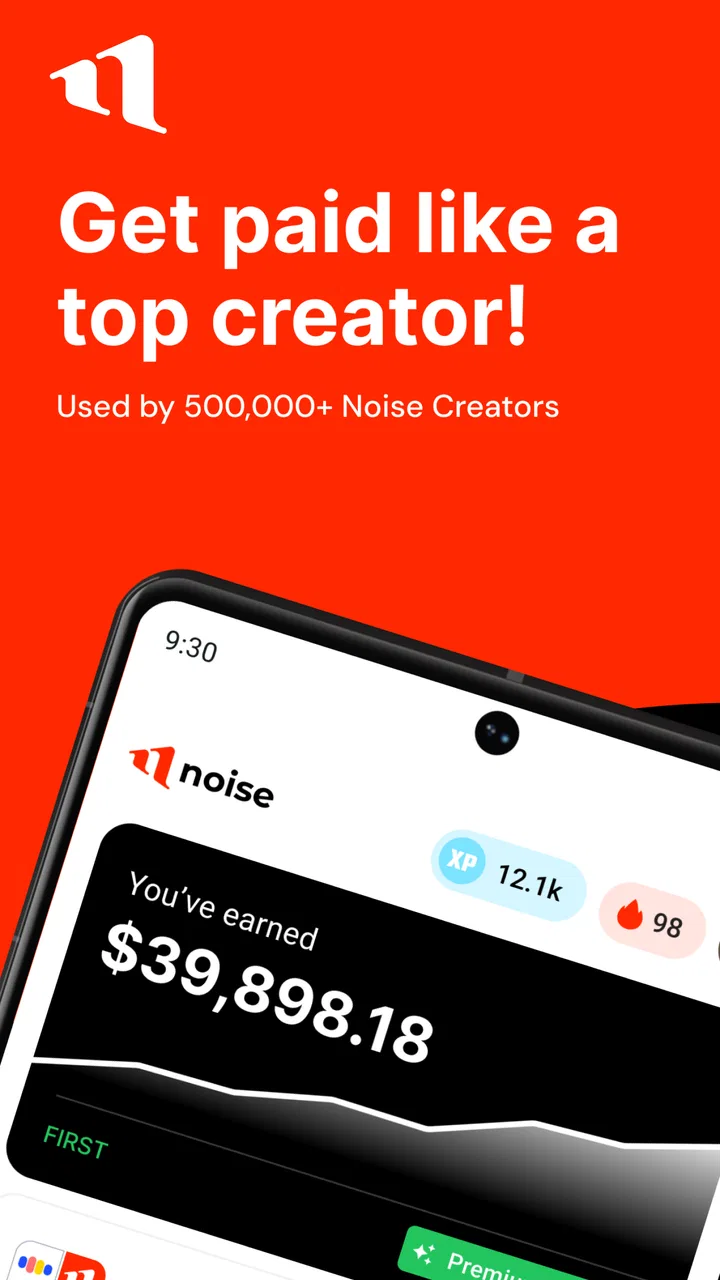
Noise - Make Money Creating
- 4.5
- Rating
- 100.00K
- Installs
- Free
- Price

 Analysis by App-foxy
I approached Noise - Make Money Creating as a work tool rather than a quick-income promise. It is a free business app from Noise Inc, built around publishing content and potentially earning from that activity. That sounds simple, but the useful question is not whether it can magically turn posts into income. The useful question is whether it can fit into a repeatable creative workflow without making the process feel scattered.
After spending time with it, my view is fairly clear: Noise is most interesting for people who already have ideas, opinions, or useful knowledge to share and want a focused place to turn those ideas into public content. It is less convincing for someone expecting a passive-income button. The app rewards consistency, clarity, and patience more than occasional bursts of enthusiasm.
Its position is also easy to understand. Noise belongs in the business and creator-work category, not in the same group as a full video editor, a private notes app, or a traditional freelance marketplace. The experience is centered on creating and posting, so its value depends heavily on what you bring to it. If you have nothing you want to say, the app will not manufacture a useful creative direction for you.
You May Also Like

 Blood Strike: 2.5 Anniversary
Blood Strike’s Loadouts Turn Every Drop Into a Tactical Gamble
A close look at Blood Strike’s custom loadouts: how fast access to signature weapons reshapes its battle royale rhythm, rewards preparation, and narrows the gap between fights.

 Pandora - Music & Podcasts
Pandora’s Music Is Easy to Start, but Harder to Recover
Pandora’s strength is its low-effort path from a seed to a station. Its weak spot is how much confidence it asks you to place in connection, setup, and quiet recovery.

 8 Ball Pool
 Is Built on Rivalries, Rematches, and Routine
A close look at the rivalries, rematches, shared routines, and unanswered safety questions that turn a quick pool match into a persistent mobile community.

 Samsung Music
’s Quiet Strength Is Playing What You Already Own
Its reach comes less from spectacle than from dependable access to a personal library. That simplicity is both the app’s strongest retention engine and its ceiling.

 AccuWeather: Weather Radar
AccuWeather Review: A Quick, Clear Forecast for Everyday Decisions
For everyday plans, the best forecast is the one you can understand quickly. AccuWeather makes rain timing, radar, and local conditions easy to act on, with a few trade-offs.

 Hill Climb Racing
Why Hill Climb Racing Still Turns Crashes Into One More Run
A tiny car, a bumpy hill and one more upgrade: Hill Climb Racing keeps resurfacing because its simple chaos makes every near-miss feel personal.
More From Our News Desk



Building a workflow before opening Noise
The best way I found to use Noise was to decide what I wanted to communicate before reaching for the phone. That does not mean preparing a complicated content calendar. It means choosing a small number of themes that I could return to naturally. For example, a person might focus on practical career lessons, small-business observations, design ideas, or explanations of a specialist subject.
That preparation matters because the app can otherwise encourage impulsive posting. A creator may open it, write the first thought that appears, publish it, and then wonder why the process feels unproductive. I got better results when I kept a short list of possible subjects elsewhere, marked the ideas that were genuinely useful, and only then shaped them inside Noise.
I also found it helpful to separate three kinds of work: collecting ideas, drafting them, and deciding what is ready to publish. Treating every thought as a finished post creates unnecessary pressure. Noise makes more sense when it is one step in a larger system rather than the entire system. A simple note, voice memo, or paper list can hold rough observations until they have a clear point.
The most important mindset shift is to treat earning as a result of useful publishing, not as the starting task. That keeps the workflow grounded. If every post is written only with immediate income in mind, the writing can become repetitive and forced. If the goal is to build a recognizable body of helpful content, monetization becomes a possible outcome of consistency rather than a promise attached to every upload.
Choosing subjects that can survive repetition
A good topic for Noise is not merely something I find interesting once. It should be a subject that can produce several distinct contributions without repeating the same sentence. This is where the app can become more valuable for professionals and independent creators: a single experience can be broken into a lesson, a mistake, a checklist, a comparison, and a practical example.
For instance, someone who runs a small online shop could write about choosing products, handling customer questions, organizing stock, and learning from a failed promotion. Those posts would feel connected without being identical. The same method works for students, consultants, artists, and people documenting a career change.
I would avoid starting with a topic that depends entirely on breaking news or constant external research. That kind of publishing schedule can make a lightweight creator app feel like another obligation. Noise is better suited to ideas you understand well enough to explain in your own words.
Capturing ideas and keeping the work organized
Once I had a subject in mind, the next challenge was turning a loose idea into something worth posting. My preferred structure was simple: begin with the problem, add the useful observation, and finish with an action the reader can take. This prevented drafts from becoming personal diaries with no clear benefit to anyone else.
That structure is especially useful when the original thought is emotional or unfinished. A frustrating workday can become a useful post if I explain what went wrong, what I changed, and who might recognize the same pattern. Without that middle step, it is easy to publish a complaint rather than an insight.
I also recommend keeping a distinction between ideas that are timely and ideas that are durable. A timely post may respond to something happening now, while a durable post can remain useful weeks later. Mixing both types gives a creator more flexibility. If a busy day arrives, a durable draft can keep the routine alive without requiring a rushed reaction.
Noise is not a replacement for a full editorial database, so I would not force it to manage every part of a large publishing operation. If I were coordinating multiple contributors, detailed approvals, complex brand rules, and long campaigns, I would use a dedicated planning tool alongside it. Noise is more comfortable as the place where the finished thought becomes a public contribution.
A practical daily scenario
Imagine a freelance designer finishing a client call in the afternoon. During the conversation, the client misunderstood a technical term. Instead of forgetting the moment, the designer records the lesson in a private note: explain specialist language before discussing solutions. Later, that note becomes a short piece of content with an example and a suggestion for other freelancers.
That routine is realistic because it does not demand a dramatic creative session. The valuable material comes from ordinary work. Noise then becomes the publishing point for knowledge that already exists, rather than a machine that requires the user to invent a new idea every day.
I would use a similar approach after customer conversations, study sessions, project reviews, or personal experiments. The key is to capture the observation close to the moment it happens, then rewrite it when there is enough distance to make it useful. That two-stage process improves quality and reduces the pressure to publish immediately.
Making each post do a specific job
Before publishing, I found it worthwhile to ask what the post is supposed to achieve. Some content explains. Some builds trust. Some starts a conversation. Some demonstrates a skill. These purposes should not be confused. A post trying to do everything often becomes vague.
A useful test is to remove the opening sentence and see whether the remaining text still has a clear point. If it does not, the draft may be relying on a dramatic introduction instead of substance. Another test is to ask whether a reader can describe the practical takeaway in one sentence. If not, I would edit again.
This is also where Noise differs from a general social platform. On a broad network, publishing may be mixed with entertainment, personal updates, and fast reactions. Noise feels more appropriate when I am deliberately presenting an idea or piece of knowledge. That focus can be an advantage, but it may feel restrictive to users who prefer casual posting.
Turning occasional posting into a repeatable routine
The strongest case for Noise is not a single successful post. It is the possibility of creating a sustainable rhythm. I would rather publish a manageable amount of thoughtful content than make an ambitious plan that collapses after a week. A routine should fit around existing responsibilities, not compete with sleep, client work, or study.
My recommended cycle is to collect several rough ideas, develop the strongest one, review it later, and then publish. The delay between drafting and posting is valuable because unclear claims and unnecessary words are easier to notice after a break. It also gives the creator a chance to decide whether the subject is still appropriate.
Consistency does not mean repeating a rigid format forever. It means showing up often enough to learn what kind of work feels sustainable. One week might favor short explanations, while another might produce a deeper personal lesson. The routine should preserve the habit while allowing the content to evolve.
For someone trying to earn through content, this distinction is important. Income-oriented work usually requires trust, and trust is difficult to build through random posts. A recognizable subject area, a dependable voice, and useful follow-through are more valuable than chasing every possible trend. Noise can support that approach, but the discipline still belongs to the creator.
Using review sessions instead of guessing
I would set aside a regular moment to review what I have published and how the process felt. The review should cover more than visible response. I would ask which subjects were easiest to explain, which drafts took too long, and which posts led to meaningful conversations or useful opportunities.
This helps identify a subtle trade-off: the topic that attracts the most attention may not be the topic that supports a healthy creative routine. If a certain subject performs well but leaves me exhausted, it may not be a sustainable foundation. Conversely, a quieter subject may be easier to maintain and better aligned with long-term expertise.
Another useful habit is to keep a small list of unfinished ideas rather than deleting them. A weak draft may contain one strong example that belongs in a future post. Reusing the lesson is not the same as reposting the same content. It is a way to protect creative energy and avoid starting from an empty screen every time.
Where the experience can fail
The biggest failure point is expecting the app itself to create demand. Noise gives a creator a place to post and pursue earnings, but it does not remove the need for a clear subject, careful writing, or sustained effort. Anyone downloading it solely because the phrase “make money” sounds immediate may become disappointed.
Another weakness is the dependence on self-direction. I had to decide what to write, how much effort to invest, and when a draft was ready. That freedom is useful for an independent creator, but beginners who need a detailed course, guided prompts, or a complete business plan may find the experience too open-ended.
There is also a quality risk. When publishing becomes part of a routine, it is tempting to lower the standard just to maintain momentum. I would rather skip a weak idea than fill the feed with content that says very little. A sustainable system needs a minimum quality threshold, even if that means posting less often.
Privacy and professional judgment deserve attention too. Work stories can contain confidential details, and personal experiences may involve other people. Before posting, I would remove names, identifying circumstances, and sensitive information. This is not a Noise-specific trick; it is essential whenever real work becomes public content.
The app may also be the wrong choice for users whose main goal is polished multimedia production. If your work depends on advanced video editing, complex graphics, extensive scheduling, or a large team review process, a specialized tool will probably serve you better. Noise is more appealing when the core value is the idea and the act of publishing it.
When another option makes more sense
A private notes application is better for raw brainstorming, especially when the material is sensitive or still confusing. A professional networking platform may be preferable when the main objective is direct career visibility among established contacts. A freelance marketplace is a better fit when you want to bid on defined client projects rather than build an audience through content.
Noise occupies a different middle ground. It is for people who want their own ideas to become part of a public, potentially income-producing practice. That can be liberating, but it also means the user must accept more responsibility for positioning, editing, and patience.
I would not recommend installing it as a replacement for every other creator tool. I would recommend testing it as the publishing layer in a modest system: capture ideas in the tool you already trust, develop them with a clear audience in mind, and use Noise when the content is ready to share.
Who should adopt Noise and how to start
Noise is a good match for an independent creator, specialist, student, small-business owner, or professional who can explain useful things from personal experience. It is particularly suitable for someone who wants to build a body of work gradually rather than depend on one viral moment.
It is also approachable from a cost perspective because the app is free, and its Everyone age rating makes it broadly accessible. The Android release requires version 7.0 or later, so users with older devices should check compatibility before planning their workflow. Noise Inc is the developer behind the app, and the current version is 1.8.1.
The app has reached over one hundred thousand installs and holds a 4.6 average from roughly five thousand seven hundred ratings, with hundreds of written reviews. Those figures suggest that the concept has attracted a meaningful audience, although popularity should not be confused with a guaranteed personal result. The app was released on October 18, 2024, so I would still approach it as a relatively young product and keep expectations practical.
My suggested starting plan is deliberately small. Choose one subject you understand, prepare a handful of ideas, and publish only the ones with a clear reader benefit. After that, review the process rather than obsessing over immediate earnings. Did the writing fit your schedule? Did you enjoy explaining the topic? Could you repeat the work without resenting it?
Those questions reveal whether Noise belongs in your routine. If the answers are positive, the app can become a useful home for a focused content practice. If you need instant returns, highly automated publishing, or the production depth of a full media suite, you should skip it or pair it with a more specialized alternative.
My final impression is that Noise - Make Money Creating works best when I use it with a clear workflow before and after the app. It is not the whole business, and it is not a shortcut around learning how to communicate. Its strength is giving motivated creators a direct place to turn practical knowledge into published work.
I would recommend it to a friend who already has something worthwhile to say and is willing to build patiently. I would not recommend it to someone looking for effortless income. Used with realistic expectations, thoughtful editing, and a repeatable routine, Noise can be a sensible addition to a creator’s productivity system.
FAQs for Noise - Make Money Creating
01What is Noise - Make Money Creating and how does it work?
Noise - Make Money Creating is an app that allows users to earn money by creating and sharing content. Users can upload videos, photos, and other media, gaining followers and views in the process. The app monetizes your content through ads and sponsorships, offering a unique platform for creatives looking to turn their passion into profit.
02How can I start earning money on Noise?
To start earning on Noise, first, download the app and create an account. Once you're set up, begin uploading your creative content. The more engaging and popular your content, the more views and followers you will gain. Earnings are generated through ad revenues and sponsorships, which are shared with creators based on their content's performance.
03Is there a cost to use Noise - Make Money Creating?
There is no cost to download or sign up for Noise - Make Money Creating. The app is free to use, with no subscription fees. However, it may offer in-app purchases or premium features that could enhance your user experience or increase your earning potential. Always check for any associated costs before committing to these features.
04What types of content are most successful on Noise?
On Noise, content that is unique, engaging, and aligns with current trends tends to perform the best. Popular categories include lifestyle, tutorials, travel, and entertainment. Creators should focus on quality, originality, and consistency to attract and retain viewers, thereby increasing their chances of earning money from their content.
05Are there any restrictions or guidelines for content creation on Noise?
Yes, Noise has specific guidelines to ensure a safe and respectful environment. Content must adhere to community standards, which prohibit explicit, offensive, or harmful material. Creators should familiarize themselves with these guidelines to avoid content removal or account suspension. Always ensure your content is original and complies with copyright laws.
Pros
- User-friendly interface for easy navigation.
- Quick payout options for creators.
- Diverse content creation tools available.
- Strong community support and interaction.
- Seamless integration with social media platforms.
Cons
- Limited to specific regions for payouts.
- Occasional bugs in the app performance.
- Ads can be intrusive at times.
- Requires a stable internet connection.
- Limited analytics for content performance.

Noise - Make Money Creating
Gallery